How to Choose the Right Bandsaw Blade for Metal
Metal is not impressed by the most expensive blade on the rack. It wants the right blade for the job.
Thin-wall tubing and a six-inch solid bar may both be mild steel, but they should not be cut with the same TPI. A fine blade can pack with chips in a large solid. A coarse blade can hammer through thin tubing with too few teeth engaged and strip them off.
To choose the right metal-cutting bandsaw blade, consider:
- The metal and its hardness
- Whether the workpiece is solid, tubing, pipe, a profile or a bundle
- How much metal the blade passes through at one time
- The blade dimensions, speed and coolant requirements of your saw
Already know your blade length, width, material and TPI? Head directly to our Bandsaw Blade Builder. Otherwise, this guide will help you narrow down the right combination.
Metal Bandsaw Blade Selection at a Glance
| What are you cutting? | Start with | Typical TPI direction |
|---|---|---|
| Mild or carbon steel tubing and sheet | Matrix Bi-Metal | 8–12 or 10–14 for thin material; 6–10 for heavier walls |
| Mild or carbon steel solids | Matrix Bi-Metal | 6–10, 5–8 or 4–6 as the contact length increases |
| Stainless steel and high-alloy metals | M42 Bi-Metal | Match the pitch to the contact length; variable pitch suits many jobs |
| Large solids or demanding production cuts | M42 Bi-Metal, often with a positive rake; application-specific carbide where appropriate | A coarser pitch with enough gullet space for the chip load |
| Aluminum and other non-ferrous metals | Bi-metal or application-specific carbide | About 8–10 for sheet, 6–8 for pipe and 6 TPI or coarser for solids |
| Small or portable bandsaw work | A compatible Matrix or M42 blade | Often 10–14 variable pitch for common steel sections |
These are starting points. The blade maker’s application data and your saw manufacturer’s specifications should always take priority.
1. Choose the Right Blade Material
For most metal-cutting jobs, the practical choice is between Matrix and M42 Bi-Metal. Carbide is a more specialized option.
Matrix Bi-Metal: The General Shop Choice
A Matrix blade combines a tough, fatigue-resistant backing with a hardened high-speed steel cutting edge. It offers a useful balance of flexibility, durability and cost for routine metal cutting.
Choose Matrix for mild and carbon steels, tubing, structural material, maintenance work and general fabrication. If your shop cuts a mixed pile of ordinary steel rather than difficult alloys, Matrix is usually the sensible place to start.
M42 Bi-Metal: More Wear Resistance for Demanding Metal
M42 uses a harder cobalt high-speed steel tooth edge on a flexible alloy backing. The added heat and wear resistance makes it better suited to stainless steel, tool steels, high-alloy metals, heavy-wall material, solid stock and production cutting.
Harder does not automatically mean better value. For everyday mild steel, Matrix may do the job economically. Move to M42 when the material, workload or blade life justifies it.
Carbide Tipped: A Specialized Production Option
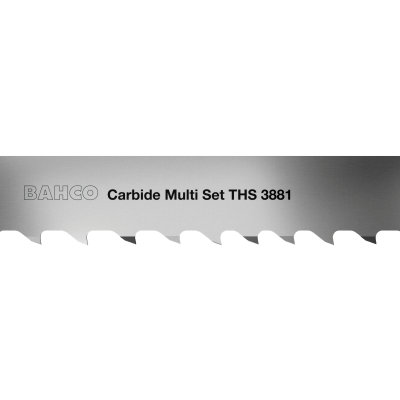
Carbide-tipped blades offer exceptional heat and wear resistance for abrasive materials, difficult alloys and high-output cutting. They also cost more and perform best on a rigid, capable machine with stable clamping and properly controlled speed and feed.
Carbide is not a universal upgrade for every saw. If bi-metal life is poor despite the correct pitch and setup, talk to us about whether a carbide blade fits your material, machine and production volume.
2. Choose TPI by the Metal in the Cut
TPI means teeth per inch, but the number on the blade is only half the decision. The other half is the contact length: the amount of metal the teeth pass through at one time.
For solid stock, contact length is roughly the diameter or thickness at the widest part of the cut. For tubing, angles, channels and bundles, it changes as the blade moves through the shape.
The goal is to keep enough teeth engaged to share the cutting load without putting so many teeth in the cut that the gullets cannot carry the chips away.
Variable-Pitch TPI Starting Chart
| Variable pitch | Approximate contact length | Common starting point |
|---|---|---|
| 10–14 TPI | Less than 0.8 in. | Thin-wall tubing, sheet and small sections |
| 8–12 TPI | 0.4–1.2 in. | Tubing, profiles and small solids |
| 6–10 TPI | 0.8–2 in. | Heavy-wall tubing and small-to-medium solids |
| 5–8 TPI | 1.2–2.4 in. | Medium solid stock |
| 4–6 TPI | 2–3.9 in. | Medium-to-large solids |
| 3–4 TPI | 3.1–6.7 in. | Large solid stock |
| 2–3 TPI | 5.9–11.8 in. | Very large solids |
The overlaps are intentional. Material hardness, tooth geometry, machine rigidity and whether the cut is continuous or interrupted can shift the best choice. Use the chart to narrow the field, then confirm that the pitch is available and recommended for the specific blade.
What Happens When the TPI Is Wrong?
If the pitch is too coarse, too few teeth carry the load. Each tooth takes a heavy bite, which can cause grabbing, chatter and stripped teeth—especially in thin-wall tubing.
If the pitch is too fine, the small gullets can fill before they leave the cut. The blade rubs instead of cutting efficiently, creating heat, slowing the cut and increasing the risk of tooth damage or a crooked result.
As a broad rule, keep at least three teeth in the metal at all times. Treat three as the minimum, not the target; several teeth should normally share the load.
Tubing, Profiles and Bundles Need Extra Thought
Do not choose a blade for two-inch square tubing as though it were a two-inch solid bar. The wall thickness—and how the shape sits in the vise—determines how many teeth meet metal at once.
Variable pitch is usually a good fit for tubing, pipe, angle, channel and other interrupted cuts because it handles changing tooth engagement with less vibration. For bundles, consider the combined contact across all pieces and clamp them securely. Any movement during the cut can damage teeth quickly.
3. Understand Constant and Variable Pitch
A constant-pitch blade has evenly spaced teeth. It can work well in consistent solid material on a rigid machine where tooth engagement stays steady.
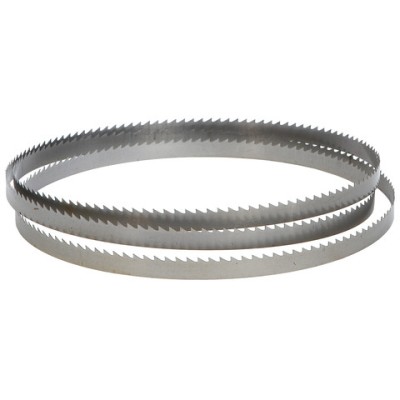
A variable-pitch blade changes the spacing and often the tooth size within a repeating pattern. A 6–10 TPI blade does not have 16 teeth per inch; its spacing varies between the 6 and 10 TPI range. This breaks up rhythmic vibration, reduces chatter and lets one blade handle a broader range of sections.
That versatility is why variable-pitch blades are common in fabrication shops and a strong starting point for tubing, profiles and mixed-size work.
4. Make Sure the Blade and Saw Match
The right tooth edge and pitch cannot compensate for a blade that does not fit—or a saw running at the wrong speed.
Width, Thickness and Length
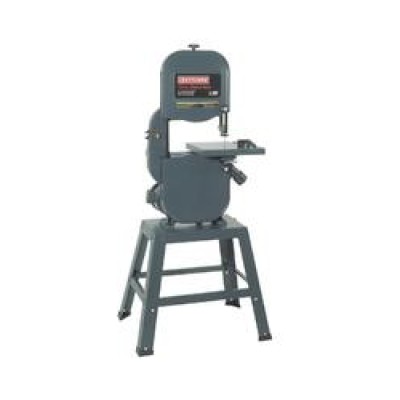
On a horizontal cutoff saw, use the width and thickness specified by the saw manufacturer. A wider blade can provide more beam strength, but the wheels, guides and tension system must be designed for it.
If you are contour-cutting metal on a vertical saw, blade width also controls turning radius: a narrower blade turns tighter, while a wider blade tracks straighter.
Confirm the exact blade length on the saw’s data plate, in the owner’s manual, on the current blade or in our Bandsaw Length by Make and Model Guide.
To measure an existing blade, mark one point and roll the complete loop along a tape measure until the mark returns to the starting position. Measure twice: custom-welded blades are manufactured to the length you provide.
Blade Speed Matters
Putting a metal-cutting blade on a standard high-speed woodworking bandsaw does not turn it into a metal-cutting saw. Steel is generally cut at a fraction of woodworking blade speed, and the correct speed varies by alloy and blade type.
Use a metal-cutting or suitable variable-speed saw, then follow the blade and machine recommendations for speed and feed. If the machine has a coolant system, use the correct fluid, concentration and flow. Portable and dry-cutting saws should be operated as their manufacturers specify.
5. Protect the Blade You Just Chose
A well-selected blade can still fail early if the work moves, the guides are too far from the cut or chips are carried back into the material.
Before cutting:
- Clamp the work securely, especially tubing and bundles
- Set the guides close to the work without interfering with the cut
- Check blade tension, tracking and guide condition
- Make sure the chip brush is working
- Use the correct speed, feed and coolant for the material
Break in a new bi-metal blade instead of pushing it at full production feed immediately. Run at the recommended blade speed, begin at roughly half the normal feed rate and increase the feed gradually once the cutting edges have settled in.
Ready to Build Your Metal-Cutting Bandsaw Blade?
Once you know the length, width, blade material and TPI, enter your specifications in our online builder to see the available combinations and pricing.
Skookum custom bandsaw blades are cut and precision-welded to your specified length in Winnipeg, Manitoba—made for your saw and the metal you need to cut.
Build Your Custom Bandsaw Blade
Still unsure? Call us at 250-590-2178 (for toll free 1-888-665-6936) or shoot us an email [email protected]. Tell us your saw make and model, the metal grade, the shape and dimensions, and whether you are cutting single pieces or bundles. We will help you narrow it down.